In my previous post, I looked at how to sell AI wall art as a beginner.
Wall art is a simple place to start, but it’s also a crowded market. And if you’re thinking about creating other digital products, there’s a more important question to answer first:
What should you actually sell?
That’s where finding the right niche comes in.
You don’t need to find a market with zero competition. In fact, a little competition can be a good sign because it means other people are already trying to sell something to that audience.
What you’re looking for is a specific group of people with a problem, a need, or a reason to make something easier.
Here’s a simple way to start.
1. Think About People First, Not Products
One of the easiest mistakes to make is starting with the product.
“Should I make a planner?”
“Should I make a spreadsheet?”
“Should I make a Notion template?”
Instead, start with a different question:
Who am I making this for?
Think about specific groups of people, hobbies, professions, or life situations.
For example:
- Teachers
- Freelancers
- First-time home buyers
- Job seekers
- Small business owners
- Plant lovers
- Marathon beginners
- College students
Once you have a specific audience in mind, it’s much easier to think about what they might actually need.
For example, instead of creating a generic budget spreadsheet, you could make a simple monthly budget tracker for college students.
Instead of a generic fitness planner, you could create a workout tracker for people training for their first marathon.
The product becomes more specific because the person you’re creating it for is more specific.
And that’s usually a better place to start.
2. Look for a Problem You Can Make Easier
A good digital product doesn’t have to solve a huge problem.
Sometimes, it just saves someone time.
Think about things people repeatedly do from scratch.
Maybe a teacher spends time creating classroom newsletters.
Maybe a freelancer needs to send similar proposals to clients over and over.
Maybe a job seeker keeps adjusting the same resume for different applications.
These are potential opportunities because a template, checklist, planner, spreadsheet, or guide could make the process easier.
A simple question to ask is:
What is my target audience already spending time doing that could be made easier with a digital product?
You don’t need to invent something completely new.
Sometimes, making an existing task a little faster or simpler is enough.
3. Use Search to See What People Are Looking For
You don’t need expensive market research software to get started.
Begin with places where people are already searching.
Try typing a broad idea into Etsy, Google, or Pinterest and look at the related searches that appear.
For example, instead of searching only for “budget template”, try adding open-ended search phrases like:
"budget template for...""budget planner for..."
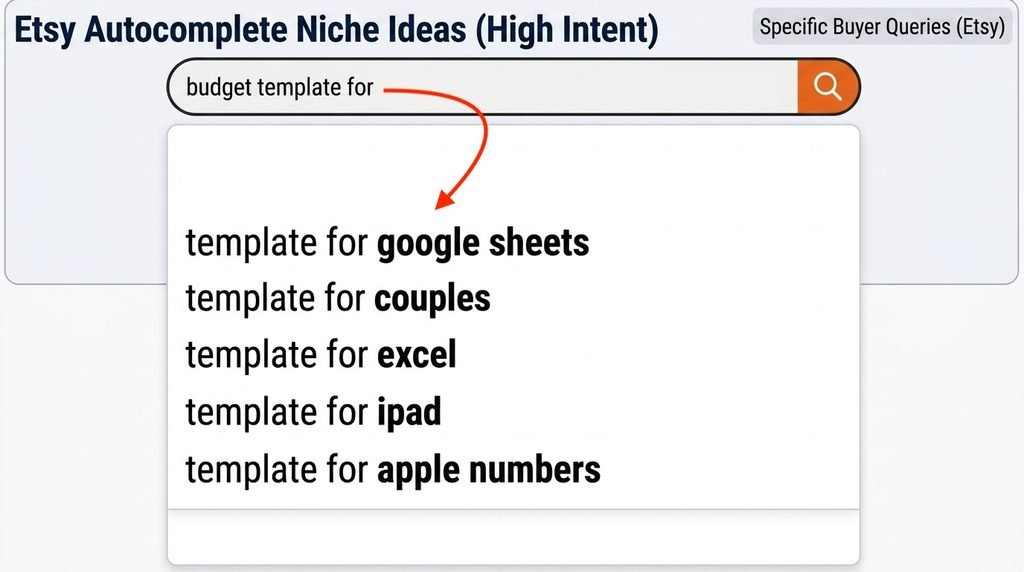
The goal isn’t to treat autocomplete as proof that people will buy something.
It’s simply a quick way to discover the words and phrases people use when looking for a solution.
Google Trends can take this a step further. It uses aggregated search data to show how interest in a search term or topic changes over time. Just remember that Google Trends measures search interest, not buying intent, so it’s best used as one piece of the puzzle rather than proof that a niche is profitable.

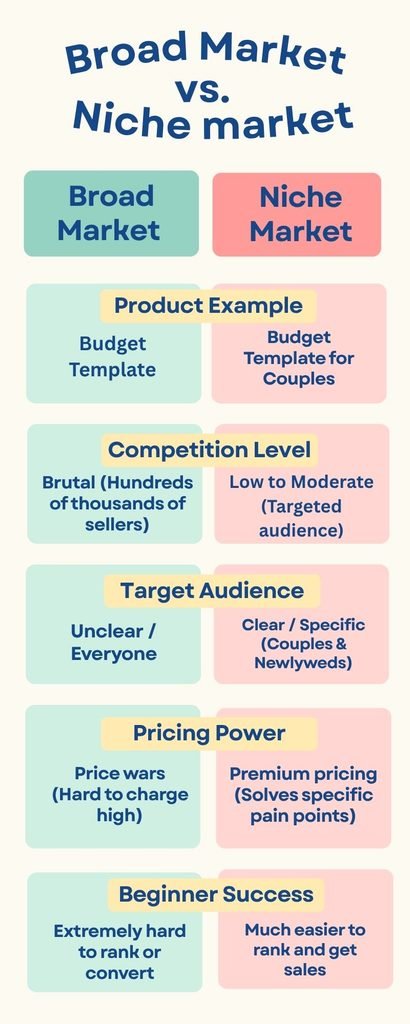
Looking at Google Trends, you’ll often see that broad terms like “budget template” have more search interest than more specific terms like “budget template for couples.”
But more search interest doesn’t automatically mean a better opportunity for a new seller. Broad keywords can attract a much wider audience and often have more competition, while a more specific niche can help you target a clearer group of buyers and create a product that fits their needs more closely.
The goal isn’t to find the keyword with the most searches. It’s to find a specific audience with enough interest and a clear reason to buy.
4. Use Etsy’s Search Data If You’re Selling on Etsy
If Etsy is one of the marketplaces you’re considering, there’s actually a useful research tool built into Etsy now.
Marketplace Insights gives sellers access to Etsy’s own search data. You can enter a keyword and see things such as how often shoppers have searched for it, how many listings are competing for that search, related search terms, and recent trends. Etsy currently allows sellers to make up to 15 keyword searches per week for free.
This is much more useful than trying to guess whether a niche has “enough” demand based on the number of search results.
For example, imagine you’re considering making a meal-planning product.
You could compare searches such as:
- meal planner
- weekly meal planner
- meal planner for families
- meal planner for college students
- meal prep planner
You’re looking for differences in search interest and competition that might help you narrow down the idea.
You still won’t know for certain whether your product will sell.
But you’ll be making the decision with actual marketplace data instead of guessing.
5. Look at What Already Sells
Once you have a few niche ideas, look at the products that already exist.
This might seem strange at first.
If you’re trying to find a niche, why would you want competition?
Because existing products can tell you something important:
People are already interested in the problem.
Look at the top listings and ask yourself:
- What are they selling?
- Who are they targeting?
- What price range are they using?
- What do their product images look like?
- What do customers mention in their reviews?
- Is there anything missing?
You aren’t trying to copy another seller’s product.
You’re trying to understand the market.
Etsy has also updated its seller guidance around listing titles and search visibility, emphasizing buyer-friendly, clear titles and its broader search system.
That means your research should go beyond simply counting how many products appear in a search.
Pay attention to what customers are actually looking for and how existing sellers are meeting that need.
6. Look for the Gap
This is where your niche can become more interesting.
You don’t necessarily want to compete by making exactly the same product as everyone else.
Instead, look for a small gap.
Maybe existing products are too complicated.
Maybe they’re designed for a very general audience.
Maybe the instructions aren’t clear.
Maybe the design feels outdated.
Or maybe nobody seems to be targeting a particular group of people.
For example, imagine you find hundreds of generic meal planners.
Instead of making another generic meal planner, you might create:
A Simple Weekly Meal Planner for Busy College Students
Now you have a clearer audience and a clearer reason for the product to exist.
You aren’t trying to beat every meal planner on the internet.
You’re trying to make something that makes sense for one specific type of person.
That’s the idea behind niche products.
7. Don’t Assume Low Competition Means High Opportunity
This is worth remembering.
If you search for a very specific idea and find almost nothing, that doesn’t automatically mean you’ve discovered a hidden opportunity.
There might simply be very little demand.
At the same time, seeing lots of competition doesn’t automatically mean you should give up.
Competition can be a sign that people are already spending money in that market.
So instead of looking for a magic number, look for a combination of signals:
Some demand + a specific audience + a problem you can solve + room to make your product different.
There is no formula that can guarantee a profitable digital product.
You’re simply looking for an idea that seems promising enough to test.
8. Pick One Niche and Move On
This might be the hardest part.
It’s easy to keep researching.
You find one interesting idea, then another one looks even better.
Before long, you’ve spent two weeks researching niches and haven’t created anything.
Don’t let that happen.
Once you’ve found an idea that looks promising, give yourself permission to test it.
Start with:
- One specific audience
- One clear problem
- One simple digital product
That product could be a template, checklist, planner, spreadsheet, printable, or short guide.
You don’t have to commit to that niche forever.
You’re just testing an idea.
If it doesn’t work, you’ve learned something.
If it does work, you have a starting point for your next product.
Final Thoughts
Finding a niche isn’t about discovering some secret market with no competition.
It’s about finding a specific group of people, understanding what they need, and creating something that makes their lives a little easier.
You also don’t need to spend weeks doing market research before you create anything.
Start with a few ideas, look at the search data, study the competition, and pick the one that gives you the strongest reason to keep going.
And you don’t have to figure out the product idea entirely on your own.
Once you have a few promising niches, ChatGPT can help you brainstorm product ideas, compare different audiences, and turn a vague idea into something much more specific.
That’s what we’ll look at next.
Let’s see what happens when we put AI to work.
2 thoughts on “How to Find a Profitable Niche for Digital Products”