Most AI Side Hustles Aren’t for Me.
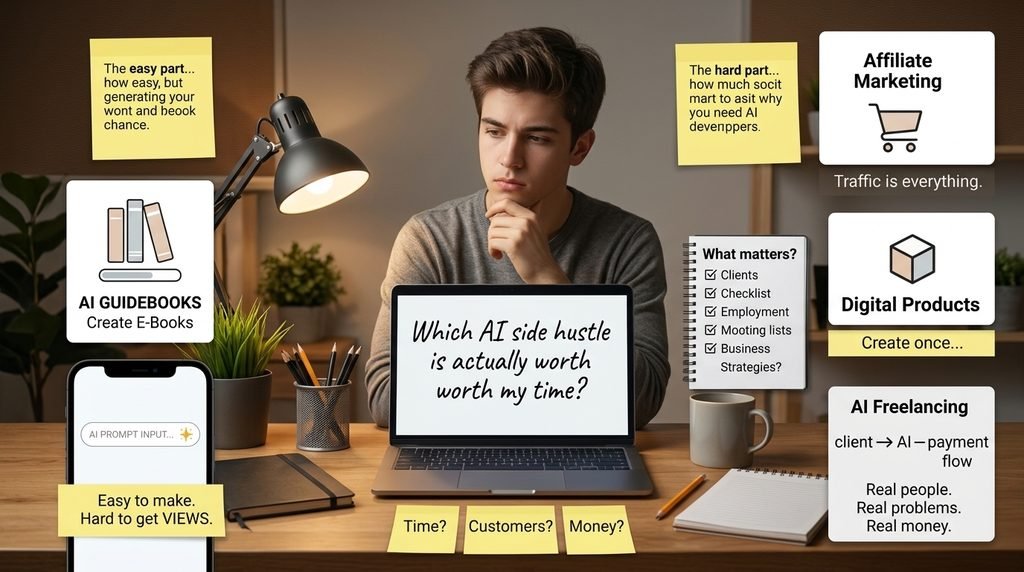
I’ve spent quite a bit of time exploring realistic AI side hustles to see how people are actually making money with AI. In my previous post, I shared how to use ChatGPT to validate digital product ideas and looked at how AI can make market research faster and more effective.
There are plenty of options.
YouTube Shorts.
Amazon KDP.
Affiliate marketing.
Digital products.
AI freelancing.
AI apps.
AI agents.
At first, it all sounds promising.
Then I started asking a more practical question:
If I were starting from zero, which of these would I actually want to spend my time on?
That changed things quite a bit.
Because there’s a big difference between something being possible and something being realistic for me.
The part nobody seems to talk about
AI has made it much easier to produce things.
You can write a book, make images, edit a video, build a website, or create a basic app much faster than you could a few years ago.
But making something isn’t usually the hardest part.
Finding someone who wants it is.
That’s why I’ve become less interested in lists of “100 ways to make money with AI.”
I don’t need another 100 ideas.
I need to know which ideas are worth trying.
So I started looking at a few of the most popular ones.
YouTube Shorts: Easy to Make, Hard to Get Seen
Shorts were one of the first things that caught my attention.
The production side is relatively accessible now. AI can help with research, scripts, voiceovers, visuals and editing.
But that doesn’t solve the main problem.
Someone still has to want to watch the video.
And if the goal is YouTube ad revenue, the numbers aren’t exactly small for a new channel. At the moment, full YPP(YouTube Partner Program) eligibility for ad revenue requires 1,000 subscribers and either 4,000 valid public watch hours in the previous 12 months or 10 million valid public Shorts views in the previous 90 days.
There are lower thresholds for some YPP features, including fan funding and YouTube Shopping, but those aren’t the same thing as qualifying for full ad revenue.
That doesn’t mean Shorts aren’t worth doing.
It just means I don’t want to assume that making videos is the same thing as building a business.
There’s another reason I’m cautious about the “just make lots of AI videos” approach.
YouTube’s current monetization policy specifically says mass-produced or repetitive content can be ineligible for monetization. It also says that AI-assisted content can be monetized when it provides original, authentic value rather than looking like generic template content.
So I’m not particularly interested in seeing how many videos AI can produce in a day.
I’d rather see whether it can help me make one video that people actually want to watch.
Amazon Affiliate Marketing: The Link Isn’t the Business
Amazon affiliate marketing sounded attractive for a different reason.
The basic idea is simple: recommend a product, send someone to Amazon, and earn a commission when a qualifying purchase happens.
But the more I looked at it, the more I realized that the affiliate link isn’t really the difficult part.
Getting the right person to click it is.
And before that, I need to get their attention in the first place.
So the real chain looks more like this:
content → attention → interest → click → purchase
If any of those steps breaks, the commission is zero.
That doesn’t make affiliate marketing a bad business model. It just makes it less attractive as a first experiment when I don’t already have an audience.
I’d rather solve the traffic problem first.
KDP: More Interesting, But Selling Is Still the Hard Part
KDP is probably one of the models I’m still interested in.
Amazon makes self-publishing relatively accessible. KDP(Kindle Direct Publishing) is free to use, and Amazon currently offers royalty options of up to 70% for eligible eBooks and up to 60% for print books. Print royalties are calculated after printing costs.
That part is appealing.
AI can also make parts of the process easier, especially brainstorming, editing, illustration and production.
But there’s an obvious trap.
Creating a book is not the same as selling one.
I could probably make an AI-assisted children’s book fairly quickly.
That doesn’t tell me whether a parent would actually pay for it.
And that’s the question I’d rather test.
Not:
“Can AI make a children’s book?”
But:
“Can I make a children’s book that somebody actually wants?”
That’s a much harder question.
And therefore, a much more interesting one.
Digital Products: Too Easy to Make
Digital products have the same problem, perhaps even more strongly.
AI can help you create templates, guides, printables and other downloadable products incredibly quickly.
That’s useful.
It’s also why I’m not particularly excited about making generic ones.
If I can create a product in an afternoon, there’s a good chance someone else can create something similar in an afternoon too.
So I don’t want to build a business around producing more generic digital products.
I’d rather start with a problem.
Find someone who has it.
Then see if I can solve it well enough that they will pay for the solution.
AI Freelancing Is Starting to Look More Interesting
This is where my thinking changed the most.
AI freelancing isn’t as glamorous as building a fully automated business.
But there is one big advantage:
You don’t necessarily need an audience first.
If a business has a problem you can solve, you can make an offer.
They can say yes.
Or they can say no.
Either way, you get useful information.
That’s a much shorter feedback loop than waiting for Google traffic or hoping a YouTube channel eventually takes off.
Of course, AI freelancing has its own problems. Competition is real, and some freelance work is becoming easier to automate.
But I like the basic idea:
Find a problem → make an offer → see if someone will pay.
That feels like a much better starting point for an experiment.
AI Apps Are Exciting. They’re Also Easy to Overbuild.
Building an AI-powered app is another idea I keep coming back to.
The tools have changed enough that building a basic product is much more accessible than it used to be.
But I think it’s very easy to make the same mistake here:
“What should I build?”
when the better question is:
“What problem is painful enough that someone would pay me to solve it?”
I don’t want to spend three weeks building something nobody asked for.
If I find a real problem first, then building the solution becomes much more interesting.
What I’m Left With
After looking at all of these, I don’t think there’s one magical AI business model.
There are just different problems.
| Model | The problem I’d have to solve |
|---|---|
| YouTube Shorts | Getting attention |
| Amazon Affiliate | Getting qualified traffic and purchases |
| KDP | Making something people want to buy |
| Digital Products | Differentiating from everything else |
| AI Freelancing | Finding a paying customer |
| AI Apps | Finding a valuable problem |
And that last part is what I’m taking away from this.
I’ve been spending too much time asking:
“What can I make with AI?”
Maybe the better question is:
“What can I help someone with using AI?”
That sounds like a small change.
I don’t think it is.
I’m Not Looking for Passive Income Yet
There’s another thing I’ve realized.
A lot of online business advice starts with the dream of passive income.
Build something once.
Automate it.
Let the traffic come in.
Collect the money.
It sounds great.
But when you’re starting from zero, I think the first goal should be much less exciting:
Get someone to pay you.
Just once.
If that happens, you have evidence that you’ve found something worth investigating further.
If it doesn’t, you haven’t wasted six months building a business around an assumption.
That’s the kind of experiment I want to run.
So What’s Next?
I’m not going to choose a business model just because it sounds good on paper.
I’m going to look for a small problem that AI can help solve, find out who might actually pay for the solution, and see if I can get a real customer.
It might turn into a service.
It might turn into a product.
It might turn into software.
Or it might go nowhere.
I’m okay with that.
At this stage, a quick “no” is more useful to me than another month of planning.
That’s what I want to explore here.
Not every idea that could make money with AI.
Just the ones that might actually be worth my time.